LED lighting, part 1
Sunday, 14 March 2010
I’m in the process of designing some new lighting for the house, which I’ll get into in detail later. For now I’m experimenting with Luxeon Rebel LEDs to evaluate the different colors and white temperatures. I started by getting a handful of “warm white” and red, green and blue Rebels. I expected the white ones to be too “cool” in temperature, so the R G and B ones could be individually adjusted to provide some warmth to compensate. I designed a simple PC board that takes three white LEDs and one red, one green and one blue one.
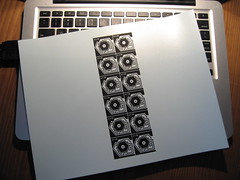

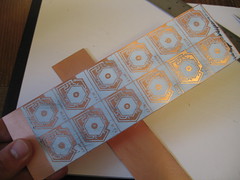
I designed the board in Illustrator and laid out several together on a page, then printed it onto a sheet of toner transfer paper (from Pulsar). I laminated it to a copper-clad board and ran it through again with a “white TRF foil” as an etch-resist layer, as the toner alone tends to be somewhat porous.
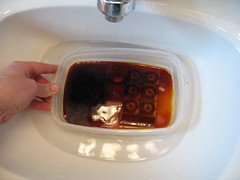
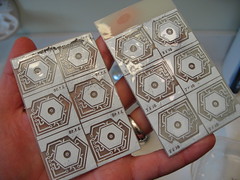
I then etched the boards with ferric chloride in a Tupperware dish floating in hot tap water in the bathroom sink, agitating the dish continuously.
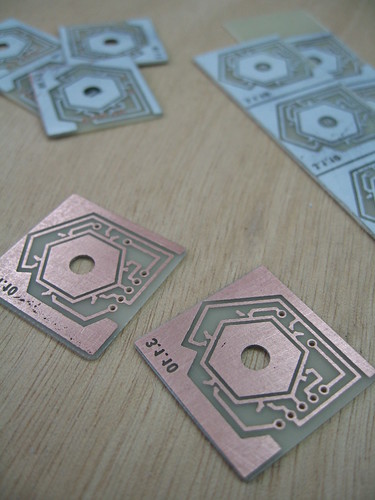
After about 25 minutes in the etchant I rinsed the boards, drilled the holes, divided them up and removed the toner from the remaining copper with lacquer thinner and a scotch-brite pad. I soldered the LEDs onto the board, along with a female header to connect wires to. For testing purposes I connected two C batteries together and plugged them into the header.
Luxeon Rebels are designed to dissipate heat through a large “no connection” solder pad directly under the chip. There are specific guidelines for the design of the PCB to draw this heat away from the LED which include a multitude of plated vias to increase the copper surface area. I’m unable to create plated vias in my homemade boards, so my intent is to mount the board to an aluminum plate, using an aluminum machine screw to draw the heat through the hole in the middle of the board.
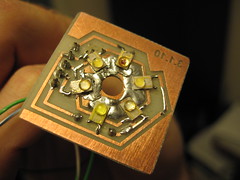
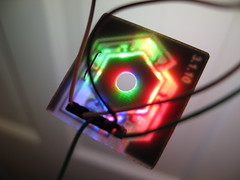
I learned some important lessons from this first attempt. The main problem is hand-soldering these tiny surface-mount LEDs to such a large copper field, which resulted in a sloppy, lumpy mess of solder. I also realized that I may need to experiment with other combinations of LEDs to get the color right. This first try produced a pleasant white light (and yes, red, green, and blue light does combine into white…I know the theory is fundamental but seeing it happen before your eyes is pretty exciting!) but compared to incandescents and even some of the warm CFLs in my house it still looks very cold.
A good first effort, with room for improvement…


No. 1 — March 16th, 2010 at 2:31 am
Hey, I always solder surface mounted stuff on my stove, on a block of aluminum. First I apply solder paste to the pads. Some kind tempsensor attached or drilled insinde the block makes you able to control the temp curve really good. The results are great!
No. 2 — March 16th, 2010 at 3:02 am
I have played a lot with Rebel Stars, and for a single led I usually calculate with 5-8cm*5-8cm passiv cooling area, that in my case reache ~40-50°C. Having 7! Leds on one board makes me very sceptical, especially since all their heat has to pass one screw.
For one led, it might work. But steel please respect that steel is not as good a heat conductor as aluminium or copper. Having stranded copper wires might work better than a screw.
No. 3 — March 16th, 2010 at 8:01 am
slibApa- Yeah the hand soldering was really a mess. Stay tuned for my skillet reflow experiences in part II…
Bernhard- There’s some interesting stuff in the Rebel Application Brief here: http://www.philipslumileds.com/pdfs/AB32.pdf. Philips shows four of these mounted pretty close together using only plated vias for cooling! You’re right about a steel screw– I have aluminum ones I plan to use. Or would copper be a better heat conductor?
No. 4 — March 16th, 2010 at 9:58 am
A “middle” approach might be “skillet preheat” at a low temp combined with hand-soldering.
No. 5 — March 16th, 2010 at 3:51 pm
Wow Joel this is great! FYI, if you’re looking for a surface-mount soldering rig, Scott Dixon over at DorkbotPDX has put together a controller PCB to drive a $15 hot-plate. It’s a nifty little rig.
http://www.dorkbotpdx.org/blog/scott_d
Chris
No. 6 — March 17th, 2010 at 7:53 am
Thanks Chris!
No. 7 — March 18th, 2010 at 3:46 pm
This is a very interesting exercise, may I ask for what purpose are you choosing the warmth of the white? Are you replicating existing light devices like reading lights, back fill / wall wash or kitchen illumination? Or are you replacing different colours for different applications?
No. 8 — March 18th, 2010 at 4:41 pm
Hi Stephen- Yes, all of those… My first requirement is for recessed lighting in a family room, but I would like to be ready to apply this anywhere/everywhere.
Generally I’m trying to create a “pleasing” light, and my starting point for that is incandescent, which is quite warm. That may be largely because we are so used to incandescent light, so it’s not to say that I can’t come up with something better.
No. 9 — March 18th, 2010 at 8:17 pm
Do you have data sheets for the Rebels you’re using? Because they should specify CIE chromaticity and gamma values and from that you can calculate the exact voltages needed for any color you want including arbitrary white points on the black body curve line:
http://tinyurl.com/yl82htc
The LEDs you use (which can be anything, not just RGB) will form a convex hull on that chart indicating the total color range possible:
http://tinyurl.com/yg3enpp
If you want very fine control around the white point then you choose LEDs closer to the middle. I could whip up a spreadsheet to do these calculations for you if it’d help any.
No. 10 — March 18th, 2010 at 11:17 pm
Cool Could post a more detail on how do this, or some links about it??? please
No. 11 — March 18th, 2010 at 11:42 pm
Re:color, to get more yellow in your light reduce the ratio of blue to the other colors.
A format to consider is:
Less red = more cyan
Less green = more magenta
Less blue = more yellow
No. 12 — March 19th, 2010 at 8:30 am
@Myndale- Woah, you’re kinda over my head there. It looks like I still have a lot to learn about color/illumination theory. Thanks for the links, I need to do some more studying!
No. 13 — March 19th, 2010 at 12:52 pm
If you want a decent warm white (<3000k) you should really avoid any RGB mixing – you will never get anything you are happy to sit and relax under.
Best off with the xicato LED but you may not be able to get hold of one very easily or cheaply. I've seen hundreds of LED products try and replicate warm white colour temperatures and the only successful product uses this xicato technology.
Good luck.
No. 14 — March 19th, 2010 at 4:04 pm
Hi Rob- Yeah I’m starting to realize the shortfalls of an RGB system. The 2700K Luxeon Rebels look promising, next step is to mock them up in the intended environment and try them out.
I’ll check out Xicato. Do they manufacture their own LEDs or do they design and build fixtures? Or both?
No. 15 — May 16th, 2010 at 10:06 am
Very smart idea’s.. new to the whole soldering things but leds is where i started off..
No. 16 — May 16th, 2010 at 10:07 am
Oh forgot to mention to keep the work up, definitely nice